Category Archives: Uncategorized

Exploring – what it is and what it isn’t

I had linked to this article by Zbigniew Minda, recently (until 2013) Federal Commissioner of the FSE, in the comments under my article on the Benedict Option. The whole article is worth reading, but the following quote, in my opinion, cuts to the heart of the matter:

When thinking about a Explorer activity we shall have in mind that we try to have always elements corresponding to five goals. We do not only play, but also pray, not only sing but also serve, not only cook, but also climb a hill, not only laugh but also serve each other. Look at the requirements for the second and the first class. There are always things concerning each of the five goals: health, manual ability, character, service, God. When you only pray, it won’t be exploring but a parish group of prayer. If you only play in the forest it won’t be exploring but young marines preparing for Afghanistan. If you only cook it won’t be exploring but gourmandize club. If you only sing it won’t be exploring but a choir. So during each activity, let’s try to do all the elements. Even during pilgrimage, do it in the Explorer manner: cook at the fire, have a fire of expression (theater with actors and songs), take photos, etc. Give each boy and girl a responsibility for the smallest aspect of your event. Your pilgrimage must be an Explorer pilgrimage not any pilgrimage. And so each activity.

Of the five goals Zbigniew mentions above, four were explicitly established by Lord Baden-Powell:

  1. Character
  2. Health and strength
  3. Handicraft and skill
  4. Service to others

I would argue that the fifth (and most important goal), sense of God, was implicit in Baden-Powell’s method; it was made explicit in the work of Ven. Jacques Sevin, S.J. (whose implementation of Baden-Powell’s method was highly praised by the Founder himself). Nevertheless, while one could argue that this fifth goal or aim isn’t entirely necessary for an “exploring” (what is usually called “scouting” in Europe and elsewhere) program, certainly one can’t have a Catholic program without this goal.

I will go even further and ask — can one have a Catholic program based on the work of Lord Baden-Powell while ignoring the work of Fr. Sevin? One issue with this is practical — why try to adapt Baden-Powell’s method to a Catholic setting when it has already been done? A second, and more important, issue is pastoral — Fr. Sevin’s work has been explicitly approved by the Popes, so Catholics who eschew it in favor of their own efforts are not thinking things through.

In 1998, Bl. John Paul II addressed the International Catholic Conference of Scouting as follows:

The meeting of the [Baden-Powell] method with the insights of Fr Sevin, S.J., has made it possible to develop an educational programme based on Gospel values, in which each young person is led to grow and to develop his personality, thus making his talents fruitful. The [Explorer] law, training young people in the way of virtue, invites them to moral rectitude and a spirit of asceticism, thus directing them to God and calling them to serve their brethren; by striving to do good, they become men and women who can play a responsible role in the Church and in society. In a troop, at camp and in other situations, [Explorers] discover the Lord through the wonders of creation, which they are called to respect. They also have a valuable experience of ecclesial life, meeting Christ in personal prayer, to which they can become accustomed, and in the Eucharistic celebration. In addition, Scout unity gives young people the opportunity of an apprenticeship for life in society with mutual respect.

Here we see that the late Pontiff is not only mouthing platitudes: it is clear that he is familiar not only with Fr. Sevin’s work but also that of Lord Baden-Powell. Explorers “discover the Lord through the wonders of creation” — does this not remind one of the sixth article of the Law, if not the entire thrust of B-P’s work?

Nine years later, Pope Benedict XVI wrote to Cardinal Richard, then Archbishop of Bordeaux and president of the French Bishops’ Conference, again mentioning Fr. Sevin with approval:

Made fruitful by the Gospel, [exploring] is not only a place for true human growth but also for a forceful presentation of Christianity and real spiritual and moral development, as well as being an authentic path of holiness.

It would be appropriate to recall the words of Fr Jacques Sevin, S.J., the founder of Catholic Scouts: “Holiness does not belong to any specific period and has no specific uniform”. The sense of responsibility inspired by the [exploring] pedagogy leads to a life in charity and the desire to serve one’s neighbour in the image of Christ the servant, relying on the grace that he bestows especially in the Sacraments of the Eucharist and Reconciliation.

In France there are a number of youth associations inspired by Fr. Sevin’s work, of which the Scouts and Guides of France, the Scouts and Guides of Europe, and the Unitary Scouts of France are the largest (and these three are identified by name by the Pope Emeritus). In the United States, mainstream “exploring,” even among Catholics, has basically ignored what Bl. John Paul II aptly called the “insights of Fr. Sevin” — why? Too European (as though “European” = “bad”)? It’s hard to say for certain. What is certain, however, is that ignoring or eschewing Fr. Sevin’s work is detrimental to a Catholic “exploring” program, while putting his work into practice is — to say the least — beneficial. That doesn’t mean that one can’t create a vibrant Catholic program from scratch, but it does mean that he is handicapping himself from the start.

Apropos of Nothing

The largest scouting and guiding association in Germany is the Catholic Deutsche Pfadfinderschaft Sankt Georg (German Scout Association of Saint George).

The Benedict Option

Monte Cassino

Monte Cassino, the monastery founded by St. Benedict

I have been trying for the past several months to write an article on what I call (with no illusions that I’m the first to do so) “fortress Catholicism.” It hasn’t been easy going. Let me begin by stating that I don’t think fortress Catholicism — by which I mean trying to keep the outside world, including the mainstream Church, from influencing one’s family, even when the cost is very high — is a good response to the current situation in the Church and in the world. Rather, we should focus on what Rod Dreher calls the “Benedict Option.” Yes, I know that some of my fellow Catholics regard Dreher as a traitor; I don’t, but even if I did, that doesn’t mean that he isn’t right about some things — or a lot of things. One can be dead wrong about the fact that Catholicism is the true religion established by Our Lord and still be right about how Catholics (as well as other traditional Christians) ought to respond to the modern crisis.

In that regard, I would like to call attention to an article in Catholic World Report by James Kalb (Dreher highlights it here) entitled “Rebuilding Catholic Society.” It is worth quoting at length:

The single most important practical goal of the Church is for Christians to thrive as Christians. The primary way that comes about, of course, is for them to love God and neighbor and live accordingly, and for their pastors to show them how to do so by word, sacrament, and example. There is more to it than that, though. We don’t become good simply by deciding to do so, and even the best words, sacraments, and examples are not enough for most of us. We respond to our total environment, and most of us need all the help we can get.

So we are likely to do better in a setting that is as Catholic as possible. That is especially so in times like the present, when secular society is comprehensively organized and pervasively anti-Catholic. Evil communications corrupt good manners. If Catholics go home from Mass and spend the rest of their time awash in pop culture and studying or working in settings that trivialize religious concerns and enforce perverse conceptions of right and wrong, the strong will no doubt survive. Not all of us are strong, though, and sink-or-swim cannot be the right approach for the Church to take toward her members.

In addition to the Church as a divine institution, we need a Catholic social world that includes the Church as an institution but also extends to the ordinary affairs of life. In a previous column I called that world “Christendom,” and emphasized that when it’s not established as a matter of law we still need it as a system of habits, institutions, and attachments to which we are loyal and by which we can more readily live a Catholic life.

The Church must engage the world while remaining in some sense unworldly, so Christendom—the social world in which Catholics carry on their lives as Catholics—is an in-between sort of affair. It is far from watertight, since it accepts secular arrangements such as markets, modern science, and legitimate government authority. Further, it reflects the imperfections of Catholics. Even saints are not perfect, and the Church includes people who are far from saintly. The leaven of the Kingdom doesn’t work instantaneously among those who have begun to accept it, so the Church must maintain a place for those who are not specially holy or even specially serious.

Now our current Pope, in continuity with his predecessors going back to at least Leo XIII, has a great love for young people in the Church. And it is young people who have the greatest potential, but are also the most malleable, and unfortunately the most easily corrupted. So it is reasonable to say our youth need their environments to be as Catholic as possible, and that by giving them such a setting we show a love and concern for their well-being that echoes that of Pope Francis and his predecessors.

One such setting is what Lord Baden-Powell called “scouting.” Other terms for the same concept might include “exploring,” “rovering,” “the outdoor life,” etc. Having some experience in that setting, I would like to consider how the “Benedict Option” might apply to youth associations falling under the umbrella of “exploring.” In the interest of full disclosure (if it’s not entirely clear from previous posts in this blog!), I am currently a leader with a group in the Federation of North-American Explorers (FNE), which is a member association of the Guides and Scouts of Europe (UIGSE-FSE). In addition, I have very little actual experience with other youth organizations so my comments must necessarily be limited to published materials that are freely available. I won’t be discussing programs, but rather identities.

Procession at summer camp with the Most Blessed Sacrament

Procession at summer camp with the Most Blessed Sacrament

How might our young people’s Catholic identity be preserved in a youth association? As Kalb writes, in a setting as Catholic as possible. Ideally, that means an association with a Catholic identity. Next might be a Catholic unit in an association with a specifically Christian identity, followed by a similar unit in a secular association. Last would be a mixed unit — I don’t think it matters much whether the mixed unit is part of a specifically Christian association or a secular one. Others might disagree but I think the pressures on our young people would be the same in either circumstance, and a fallen-away Catholic is fallen away whether he is secularized or joins another ecclesial community.

The question remains, for an association that doesn’t have a Catholic identity, is having a Catholic unit within that association enough? Even if the association has a specifically Christian identity, we still have many of the issues raised in a paper to which I linked earlier:

These so-called “unique” associations encourage the boy to observe and practice his religious duties, but it is obvious that in such a situation the possibilities of practicing [exploring] as a valuable support to religious formation and to personal life of faith are considerably reduced. As a matter of fact, the pedagogical, organizational, training support from the whole association is missing; any initiative is left to the boy’s capacities and his good will (however he is left quite alone in the comprehension of supernatural) and to the leader’s capacities for education of faith (he often acts without any serious support from his association).

It goes without saying that if the above applies to an association with a specifically Christian identity, then a fortiori it also applies to an association without such an identity. But there is another issue here as well. Mainstream “exploring” is represented in this country by a “unique” association (as described in the paper to which I linked) and as part of their law a boy must promise to be “reverent.” Reverence is fine and good, we want our Explorers to be reverent when they assist as Mass, for example, but as defined by this association it includes respect for the religious beliefs of others.

Let me be clear — I do not think there is an issue with having respect for traditional religious beliefs. Even where we disagree, as Catholics do with evangelical Protestants, we can have respect that another person holds fast to what he has been taught, even if we profess that what he was taught is wrong. But if an organization refuses to say what it means by “God,” then any sort of religious belief is permissible, including those that are not worthy of our respect (even if we respect the people who hold them). For example, can one have respect for the religious beliefs of someone who says that God is a rock or a stream? I encourage everyone to read this article and grapple with the questions raised by it. Personally, I’m reminded of an appearance by Dr. Jack Kevorkian on 60 Minutes (or perhaps another TV newsmagazine) many years ago in which he averred that his “god” was J. S. Bach! How can one respect the religious beliefs of a person who tries to define “God” in such a way? I am quite certain that Bach himself, a devout Lutheran with a Catholic sensibility, wouldn’t respect them.

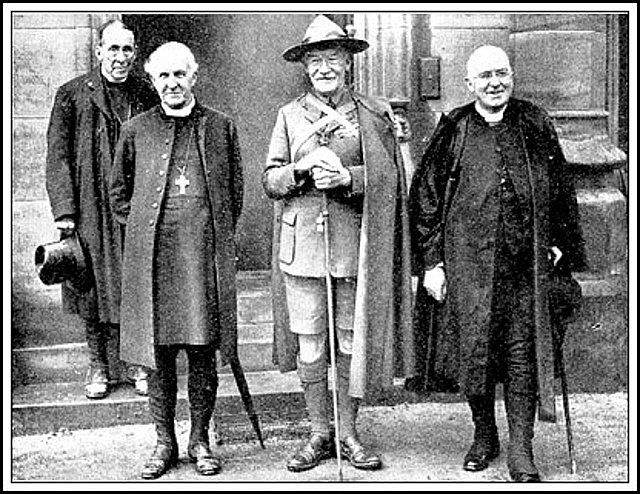
The Archbishop of Canterbury, Lord Baden-Powell, and Cardinal Bourne of Westminster

The Archbishop of Canterbury, Lord Baden-Powell, and Cardinal Bourne of Westminster

Coming back to the ideal, which I proposed was to be a part of a Catholic youth association. This isn’t always possible for various reasons. In this country — in the entire English-speaking world, in fact — these associations aren’t common. The FNE is one such association but has adopted a model of organic growth in order to protect its Catholic identity and its unique pedagogy. That has put some people off. It really must be said, however, that many people who expressed an interest in FNE lost interest as time went on, or perhaps wanted something other than what we could offer them. That should be expected — and we shouldn’t be disappointed when it happens; our way is not the only way, and certainly part of the problem with mainstream “exploring” is that it tries to be all things to all people. If the ideal isn’t available, then maybe something other than the ideal is still workable for your family. But the questions still remain — and have to be answered in one way or another.

The Growth of FNE in the USA

Our group leader/Akela on the subject of FNE in the United States. An excerpt:

Most importantly, we did not want to make promises we couldn’t keep. Still, I personally spoke to approximately 200 people who showed interest in starting new groups. Some we took on who later proved to not be very serious about starting up, and they are no longer in our development plan. We were happy to support them, but likely they were interested because this was in the news and then lost interest as time went on. However, we’ve also had a good number around the country that have shown their love for our movement and their willingness to work to bring it to the youth in their area. These have had our full support and are beginning to thrive. Yes, we want to grow, but for us, growth is something more than setting up a web form and calling whoever fills it out a group. We are truly a brotherhood and we’ll support a new group, but want that new group to also represent the FNE well and be a credit to it. Better to grow with deliberation, and retain our identity, which has been developed over nearly six decades, than to risk the future of our young association here in North America.

One wishes this sort of thing didn’t have to be said, but clarity is always good.

Public service announcement

It came to my attention recently that an association aspiring to be a scouting organization published their ranks and requirements for young members, and that one of these requirements — for 7-8 year old boys — was to learn how to Greco-Roman wrestle with their fellows. This requirement, in my opinion, shows a severe lack of judgment on the part of the association’s leadership.

Wrestling, whether freestyle or Greco-Roman, is not a sport for young boys. At the international level, boys don’t wrestle competitively until they’re at least 13 years old, and then only with a medical certificate and parental authorization. I find it mind-boggling in this day and age, when so much information is readily available on the Internet with only minimal research, that someone would think requiring 8-year old boys to wrestle with one another is a good idea. Roughhousing is one thing (and, it should be added, roughhousing is fun precisely because it is spontaneous), Greco-Roman wrestling is quite another. Someone is going to get hurt.

A far better alternative would be to teach the boys Indian arm wrestling in which two standing opponents try to wrest each other off balance. And there are other manly feats of strength that aren’t likely to end in injury.

Letter to all FNE groups from our national religious adviser

Originally published at: Federation of North-American Explorers – North Star FNE Group

Semper Parati

At the beginning of the civil year, I would like to wish to your groups a happy and holy new year. There is one thing that we should pray every single time we tighten our belts; that is “Semper Parati.”

What does it mean?

The exact and proper translation is “Always Ready”! An Explorer is someone who prepares himself to be “Always Ready.” He wants to realize his mission: “The Explorer is made to serve and save his neighbor” (Fr. Jacques Sevin, SJ).

Chivalry is the ideal of our Explorers. An ideal they took from the past to act in present time. We are not nostalgic dreamers, but we are dreamers, not in fantasy but in reality. Our dream is to serve. It is a dream we take from the past, looking to those knights, soldiers and monks. It implies temporal and spiritual duties.

Drawing the present with the past. How strange?

Because our love for God is a reality, we are happy that God wants us to live and act in this society — a society that is wounded and even fights against nature and humanity without knowing it.

It is exactly because we are living most of the time in nature that we know the riches of God’s creation. Being close to nature is being close to God, and being grounded in reality. Recalling my summer camps, there is one memory that I like to most: the campfire. At the end of the day, when we had a wonderful day in which we lived a new experience in our patrol, in which we have tried to serve our patrol members and form, together, a family gathered around the patrol staff with God’s grace. Our bodies are tired but our minds are always active because we are trying to be ready.

Ready to receive that story given by our Chief or our priest. That story they heard themselves from their chiefs coming from a time when our country’s identity was Christian. These stories came from the time when Chivalry meant service. They formed that link that we, ourselves, are living, today.

Principles and law

I cannot be “Always Ready” without knowing exactly what I am supposed to do. The source is the Explorer Law. Our fathers gave us that Law which is, in a way, that link I received from the past in order to serve in the present.

If every day, I meditate on that Law, I will understand how the Explorer movement, the Chivalry of modern times, will penetrate deeply into the souls of our boys and girls and will transform them, into happier and better men and women.

The Explorer Law is a concrete expression of the Gospel, a practical translation of principles posed by the Decalogue. Our law emerges in the heart of children and opens up into the most beautiful Christian virtues that nature and God’s grace make fruitful.

By our way of life, our way to educate in games, an Explorer receives what he needs physically in all the skills he receives at camps, and that which he acquires through the hierarchy. He acquires the art to manage his life in order to untangle others. He is a pioneer, a colonist, a missionary.

He also receives what he needs spiritually by the way he lives our way of life. You can play a game just for fun or in order to prove something to yourself or to someone else but what is the purpose? It is a really poor one!

If you do it with the virtues that are included in the Law, it is then another challenge. You are using your skills for your patrol, for your friends, to excel in your generosity.

By the Law and all the virtues that it claims: virtues of loyalty, dedication, and purity, an Explorer becomes really a knight ready to serve.

Do it without reserve, without rest, without limit, give all that you have and you will receive what is most necessary to a knight: to be “Always Ready.”

Good camps to all and may we have the pleasure to share a campfire once again altogether under the stars of Our Lady.

Hoc’h Gouez (E) a Faouëdic

Link to PDF: Semper Parati

Onward and upward! To Narnia and the North!

No, New England is not Narnia, but there is perhaps a quality in the air that can make Eustaces like myself feel like true Narnians. Akela Chris and I journeyed with Flickertail and some of our youth members to install the leaders of our new FNE group in southern New Hampshire.

Our Federation of North-American Explorers (FNE) group will always have a special place in our hearts for the North as our Canadian brothers and sisters gave so much of their time and energy toward helping our little North Star Group get started here in the United States. Now we hope to return the favor to other groups here in the U.S., insofar as we are able.

With this in mind, Akela Chris, Flickertail, and Bagheera traveled north (“onward and upward”) with several Explorers, Timber Wolves, and even Otters this past weekend to install the leaders for the Mount Monadnock FNE Group in southern New Hampshire.

We set out for NH before dawn on Saturday and rolled in around 10 am with little or no mishap. (Our boys and girls were especially impressed with the lights on the Tappan Zee Bridge as we crossed the Hudson just as the dawn broke.) We took just a short while to pack up before setting out for Mount Monadnock for what turned out to be a very long day of hiking, certainly longer than any of our youth had experienced before.

Please read more (and see pictures) here.

The “Good Parts” Version

A friend of mine once defended Peter Jackson’s “Lord of the Rings” movies on the basis that they contained all the “good parts” of Prof. Tolkien’s magnum opus. I certainly don’t have a problem with someone thinking that, but “good parts” — well, that’s a bit subjective, isn’t it? One reader’s “good parts” might be the parts that get another reader bogged down. It took me several readings before I was finally able to get through all of Book IV (the latter half of The Two Towers), but that could be someone’s favorite part for all I know. Even the **SPOILER ALERT** section in which the hobbits meet Faramir is a bit dry in my opinion.

A few of my favorite parts of the book: (1) the encounter with Tom Bombadil; (2) the Council of Elrond; and (3) Eowyn’s battle with the Witch-king. Each one of these parts is either missing or only present in radically different form in the movies. I do understand the decision to omit Bombadil from The Fellowship of the Ring. I’m not sure it would even work on film. I don’t understand the parts that were added in (e.g., Saruman’s orc midwifery), nor why every character who is not a member of the Fellowship must be stupid (Treebeard), ignoble (Faramir), or cowardly (Theoden). I don’t understand why seemingly small changes must be made that have far-reaching implications for the legendarium. For example, Elrond becomes the racist father opposed to his daughter’s interracial romance. Did the director consider the significance of this change? Elrond’s ancestry includes mortal men (Beren, Tuor) and he himself acted as Aragorn’s foster father. No, I don’t expect the films to present all of that backstory, but I do expect them to be mostly consistent with it.

Again, I don’t think less of people for enjoying the movies (my own children like them) or even for thinking that they’re better than the novel; I’m simply pointing out why I don’t find them as enjoyable as I might.

Probably the best (or worst, depending on one’s perspective) example of an unnecessary change is in the character of Faramir. **SPOILER ALERT** I don’t know if it is possible for a fictional person to be a victim of character assassination, but if so, then Faramir surely was.

Late in The Fellowship of the Ring (both the movie and the book), Boromir tries to take the Ring from Frodo. Frodo escapes, using the Ring, and the Fellowship breaks. Frodo and Sam cross the Anduin and make their way with Gollum toward Mordor; finding the Black Gate impassible they journey through Ithilien to Morgul Vale and the pass of Cirith Ungol.

On their way through Ithilien they stop and Sam cooks some rabbit stew. The smoke from the fire alerts Faramir and his men and the hobbits are waylaid. Faramir brings the hobbits to the secret outpost of Henneth Annun and Sam, under Faramir’s shrewd questioning and sensing the latter’s hidden nobility, blurts out that Frodo is the Ringbearer and that Boromir had tried to take the Ring for himself.

Here is where Faramir must make his decision. In the novel Faramir lets the hobbits go and even shows mercy to Gollum. In the movie version of The Two Towers, Faramir decides that the Ring must be brought to his father, Denethor, and only Frodo’s odd (and frankly, inexplicable) behavior in the presence of a Ringwraith among the ruins of Osgiliath convinces him otherwise. Boromir and Faramir are different, but in the movie they are virtually the same.

All the above said, there are some things I genuinely like about the movies. Gandalf’s escape from Orthanc was handled brilliantly. I like the little humanizing touches as when Boromir teaches the younger hobbits some fighting skills. And I even like Boromir’s profession of fealty as he dies from his wounds. On the whole, however, I would still rather curl up with the books.

Hobbit Day?

September 22 is “Hobbit Day.”

It won’t come as a surprise to any of my friends that The Lord of the Rings is my favorite work of fiction. It has been the one constant in my life as a reader. I could be on a John Irving kick (early in my college career), an Ayn Rand kick (later in college and early in my professional career), or a military science fiction kick (currently), but Professor Tolkien’s magnum opus is always waiting for me in my library, and picking it up to read it (which I do at least once per year) is like spending time with an old friend.

In the first chapter of The Lord of the Rings we’re told that September 22 is Bilbo Baggins’ birthday and — coincidentally? — the birthday of his cousin and heir Frodo Baggins as well. I think Prof. Tolkien has unwittingly given ammunition to practitioners of astrology as the two hobbits have a lot of similarities in their make-up despite the 78-year difference in their ages — for one, a restlessness, or a desire for wandering, that not even their closest friends share. Bilbo and Frodo are bachelors; Sam Gamgee, Pippin Took, and Merry Brandybuck only leave the Shire after their wives die.

Thou hast made us for Thyself, O Lord, and our hearts are restless until they rest in Thee.

So wrote St. Augustine in the first chapter of the first book of his Confessions. The two hobbits — who have no great honor in their own country — are restless, and I think not (merely) because of the Ring. Rather they were chosen as Ringbearers because of this restless nature, and even as the Ring passed away and its Master was defeated, the restlessness remained until they set sail from the Grey Havens and left this world (Middle-earth). Eru made them for Himself.

Of course, one won’t get any of that from reading the first chapter (“A Long-Expected Party”) of The Lord of the Rings. It shares the whimsy of the book (The Hobbit) to which it was originally intended to be a sequel, with only a little foreshadowing of the darker and deeper themes to follow. For today, then, we can join the hobbits in their feasting — open a bottle of Old Winyards, fill a pipe, and sit back to watch the fireworks. “Pray, hope, and don’t worry,” as Padre Pio (whose feast day is tomorrow) famously said. We can feast today (it is Sunday after all) and leave weightier matters for tomorrow.

Just what the world needs

Just what the world needs, another ordinary layman’s blog!

I am married, a father of four, a Roman Catholic, and a leader in the Federation of North-American Explorers (North American member association of the UIGSE-FSE) youth movement.

The Federation of North-American Explorers, or FNE, was founded in 1999 with just a few boys. As of this year our membership is around 200, and we anticipate adding several hundred more to our ranks this year alone!